
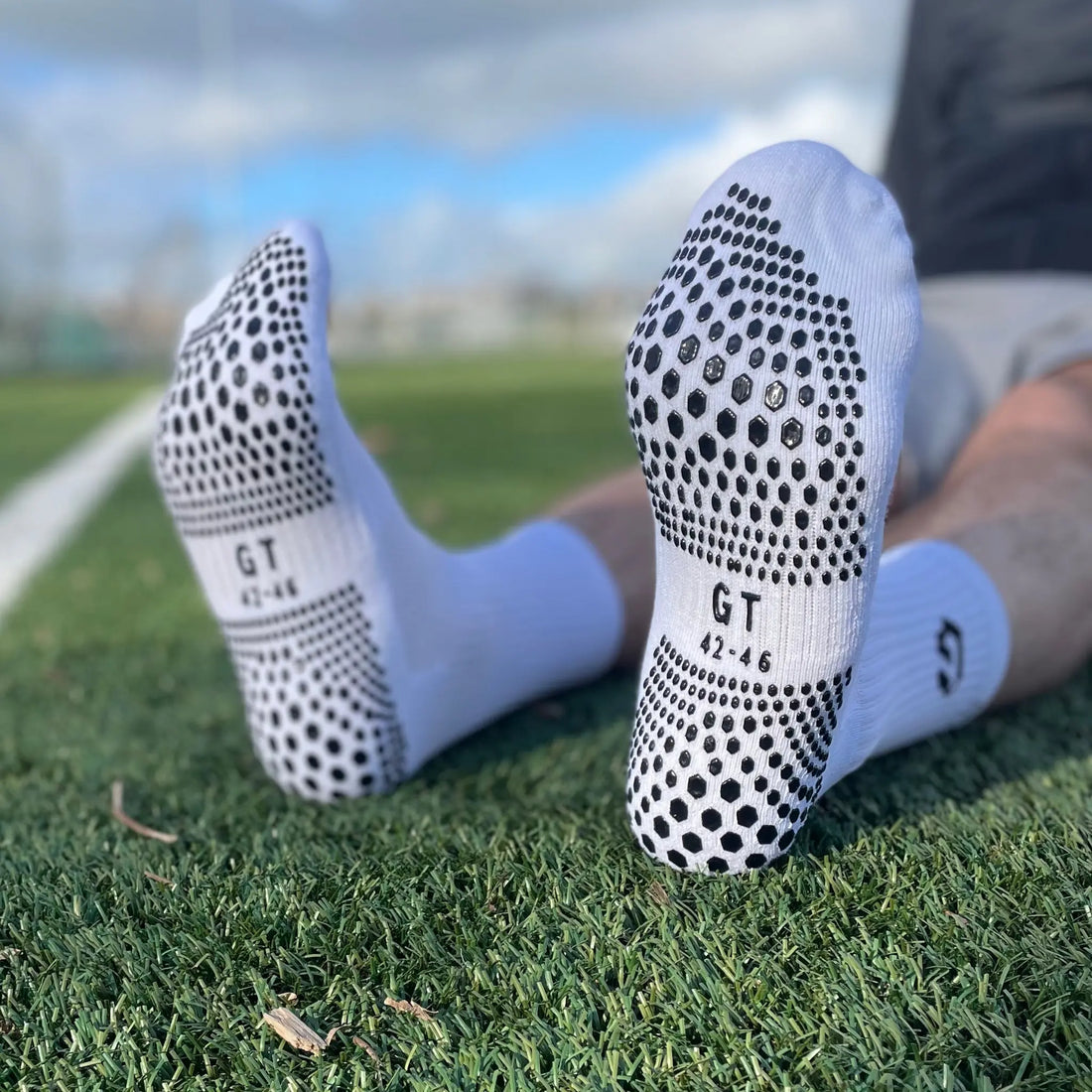
The Science Behind Grip Socks
Over the past decade, grip socks have become incredibly popular. They are said to help athletes perform better, provide more grip, and prevent injuries. But apart from all the marketing and sports hype, one important question remains: are these innovative sports socks truly scientifically proven, or are they just placebo socks with an anti-slip pattern on the sole?

Are grip socks truly scientifically proven?
Yes, grip socks are more than just a sports hype. There is scientific evidence that grip socks contribute to improved foot stability and athletic performance.
A study titled “Grip socks improve slalom course performance and reduce in-shoe foot displacement of the forefoot in male and female sports players” demonstrates that grip socks indeed have an effect.
The research shows that grip socks provide a higher static coefficient of friction compared to regular socks. Simply put: they offer more grip inside the shoe. During tests on a slalom course, participants wearing grip socks performed faster than those with regular socks.
In addition, grip socks reduced foot displacement within the shoe, especially during braking moments and sharp turns. Notably, men on average experienced slightly more foot displacement, likely due to their larger foot mass, but even for them, the grip was significantly better than with normal socks.
These results confirm that grip socks indeed contribute to better athletic performance and a reduced risk of injuries due to slipping movements within the shoe.

Do grip socks really improve your athletic performance?
Yes, there are three scientific studies demonstrating that grip socks improve athletic performance on the field.
The first study compared grip socks with regular sports socks and showed that grip socks provide better traction during braking in changes of direction. Using advanced 3D motion analysis, it was determined that grip socks better maintain the foot's position on the insole of the shoe. (Source: "Footwear insoles with higher frictional properties reduce in-shoe sliding and enhance change of direction performance")
The second study focused on rapid changes of direction, typical of team sports. Participants wearing grip socks completed a slalom course faster and reported better grip inside the shoe than with regular socks. (Source: "Footwear insoles with higher frictional properties enhance performance by reducing in-shoe sliding during rapid changes of direction")
The third study emphasized the importance of foot stability within the shoe during dynamic turns. Here too, 3D analysis was used, with grip socks with increased friction leading to both improved performance and a greater sense of stability. (Source: "Effects of athletic socks with high frictional properties on in-shoe foot sliding and performance in football-specific movements")
These three studies convincingly demonstrate that grip socks help athletes with more grip, less foot displacement, and improved performance during fast, explosive movements. So, not just a hype, grip socks are functionally proven and effective on the field.

Do grip socks prevent injuries?
Grip socks improve foot stability and reduce sliding in the shoe, which can help prevent discomforts such as blisters, stubbed toes, or sprained ankles. However, concrete scientific evidence that grip socks actually prevent injuries is currently lacking.
There are logical connections. Because grip socks provide extra friction between the foot and the shoe, they limit unwanted movements during quick turns. This can reduce potential causes of injuries such as ankle sprains or stubbed toes.
In addition, grip socks lead to less friction and less sweat accumulation, which can counteract blister formation. Due to a better fit and less sliding, the foot stays in place more effectively, which provides more comfort and potentially reduces the risk of minor irritations and skin damage.
We can conclude that although grip socks offer logical advantages in terms of stability and comfort, there is currently no direct scientific evidence that they prevent injuries. More research is needed to definitively substantiate these claims.
References
(2022) Grip socks improve slalom course performance and reduce in-shoe foot displacement of the forefoot in male and female sports players, Journal of Sports Sciences, 40:12, 1351-1359, DOI: 10.1080/02640414.2022.2080163
(2020) Footwear insoles with higher frictional properties enhance performance by reducing in-shoe sliding during rapid changes of direction, Journal of Sports Sciences, 38:2, 206-213, DOI: 10.1080/02640414.2019.1690618
(2023) Effects of athletic socks with high frictional properties on in-shoe foot sliding and performance in football-specific movements, Footwear Science, 15:3, 185-191, DOI: 10.1080/19424280.2023.2212628
Ready to feel the difference? Discover the Classic GT GRIP Socks.